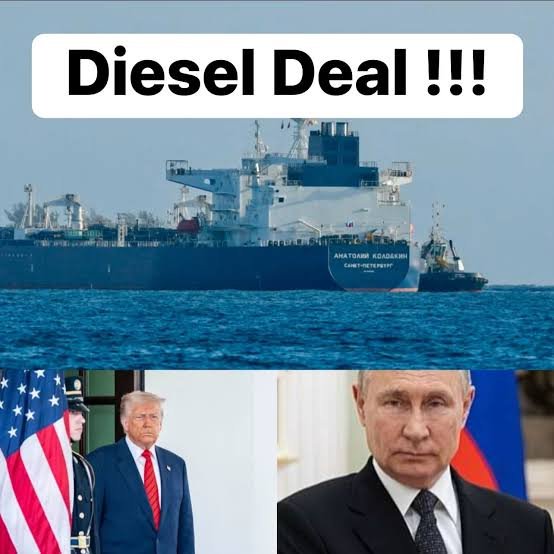
The Trump administration has announced a deal to purchase diesel fuel from Russia, marking a significant shift in U.S. policy toward Moscow. President Donald Trump said on Friday that Russia will immediately supply more than 300,000 tons of diesel, with additional shipments of 500,000 tons in November and one million tons shortly after.
The announcement followed a phone call between Trump and Russian President Vladimir Putin. Trump said the two leaders discussed the deal, which he described as a measure to address high fuel prices ahead of the U.S. midterm elections.
The U.S. has not imported Russian oil or gas since 2022, when the Biden administration imposed a ban following Moscow’s full-scale invasion of Ukraine.
Ukraine Reacts
Ukrainian President Volodymyr Zelenskyy criticized the deal in a statement released by the Ukrainian Embassy in Washington. He called it ‘a weak decision, unfortunately, a weak decision by strong partners’.
Zelenskyy also wrote in a lengthy online post that Russia would repay the deal ‘with further terror and perfidy.’ He said the agreement ‘plays into Russia’s hands — allowing it to kill more, wage’ the war.
‘I believe our team is simply being used as a smokescreen. And that is certainly not fair. It is certainly not how partners should treat each other,’ Zelenskyy said.
Democrats Call It a Betrayal
Senate Democratic leader Chuck Schumer, along with Sen. Jeanne Shaheen and Sen. Elizabeth Warren, called Trump’s announcement a betrayal of Ukraine, European allies and U.S. national security.
‘Enough is enough,’ the senators wrote. ‘The President must end his war with Iran instead of funding Russia’s war machine.’
Contrast with Recent Sanctions Law
The diesel deal comes just weeks after Trump signed a sweeping Russia sanctions law aimed at clamping down on oil and gas revenues that fuel Russia’s war against Ukraine.
The law directs the administration to impose tariffs of up to 100 percent on top importers of Russian oil or natural gas. It also envisions sanctions on Russian officials, banks and a shadow fleet of tankers.
The move casts doubt on the likelihood of the White House imposing new sanctions on Russia this month, given that the law passed overwhelmingly by Congress directs the administration to target countries that purchase Russian oil and gas.
Energy Prices and Political Pressure
Gas prices globally have surged as the war in Iran upends the energy sector. The national average for a gallon of diesel in the U.S. was $6.23 on Friday, according to AAA, after hitting a record $6.52 on Sept. 22.
Trump said in his announcement, ‘Lower prices for Americans, especially our Great Farmers, Ranchers, and Truckers, is my Greatest Priority.’
Later, as he left the White House for a campaign rally, Trump said, ‘I want to thank President Putin. To be honest with you, we have massive amounts of oil coming into our country, and it’s diesel, which is what we want. So, thank you.’
He did not answer shouted questions about the criticism from Zelenskyy.
Kremlin Statement
A statement from Putin released by the Kremlin said that during the call, he and Trump dedicated ‘significant attention to the prospects of resolving the Ukrainian crisis’ and also discussed ‘the situation around Iran and various aspects of bilateral relations.’
Russia ‘confirmed its readiness to supply oil and oil products to the American and global markets,’ Putin said. ‘I am confident that this will have a positive impact on the entire global economy.’
Russian presidential aide Yuri Ushakov, speaking later to reporters, would not say whether the U.S. made any concessions in exchange for the supplies or what, if anything, was promised to Russia in exchange.
Also Read: Pentagon Confirms Livestreamed Firing Squad Execution of Fort Hood Shooter Nidal Hasan.
Diplomatic Talks Continue
The announcement came as Trump’s envoy Steve Witkoff and son-in-law Jared Kushner were meeting with Ukrainian officials in Miami to discuss a proposal to end the Russia-Ukraine war.
The two-day talks involve U.S., Ukrainian and European officials. National security advisors from Britain, France and Germany were invited, along with representatives of NATO and the European Union.
Secretary of State Marco Rubio warned Thursday that the conflict had reached a potentially explosive impasse. ‘The other way that stalemates end is through escalation,’ Rubio told reporters in Lisbon, warning that the conflict could spread to neighboring NATO countries.
The U.S. Treasury Department said it was issuing a temporary license to allow Russian diesel to flow to global markets.
The White House did not immediately respond to questions about who was paying for the Russian diesel or when it would become available.