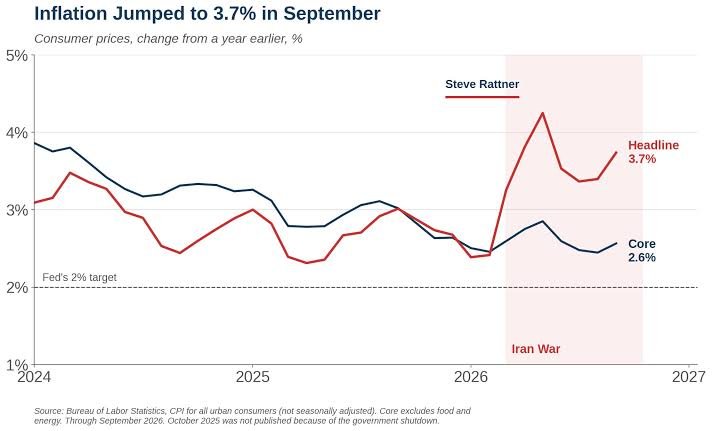
U.S. consumer prices rose more than expected in September, with a sharp rise in energy costs pushing annual inflation to 3.7%, the biggest annual increase in five months and above the 3.6% forecast by economists.
The Labor Department reported on Wednesday that the Consumer Price Index rose 0.6% on a seasonally adjusted basis from August. Core prices, which exclude volatile food and energy items, rose 0.3% this month and 2.6% over the past year.
Both of these core figures were slightly higher than expected. Economists had forecast a 0.2% monthly increase for core inflation and a 2.5% annual increase.
Energy Drives Headline Gain
The energy index rose 5.2% in September and has climbed 20.4% over the past 12 months. Gasoline prices alone jumped 9.1% for the month, accounting for more than half of the overall monthly increase in the all-items index.
Fuel oil recorded the sharpest annual gain, rising 74.2% compared to a year ago. Gasoline prices are up 34.2% year-over-year.
The September surge in energy costs follows a sustained rise in crude oil prices. Brent crude averaged $114 per barrel during the month, up $23 from August. The daily price peaked at $131 on September 15.
At the pump, the national average for regular gasoline reached $4.33 per gallon in September, according to AAA. That figure is 50 cents above the previous September record set in 2023.
Food and Housing Costs Rise
Food prices increased 2.5% over the past year. Food away from home rose 3.5% annually, while food at home advanced 1.8%.
Within the food category, nonalcoholic beverages and beverage materials recorded a 3.8% annual increase. Cereals and bakery products rose 2.1%.
Housing costs continued their steady climb. The shelter index rose 0.4% in September after a 0.3% gain in August. Rent of primary residence increased 2.8% year-over-year, while owners’ equivalent rent rose 4.4%.
Airline fares posted a significant annual increase of 22.4%, reflecting higher jet fuel costs. Motor vehicle maintenance and repair rose 5.8% over the year, and hospital services increased 5.6%.
Core Inflation Shows Broadening Pressure
The 0.3% monthly rise in core prices matched August’s pace and defied forecasts for a slowdown. The result suggests that price pressures are not confined to the energy sector.
Several categories within the core index showed gains. Recreation, used cars and trucks, education, medical care, and apparel all recorded increases. Used vehicle prices rose despite a 1.1% decline in the Manheim Used Vehicle Value Index, a wholesale measure that typically leads retail prices.
Information technology commodities rose 0.9% for the month and have climbed at a 10% annualized rate over the past three months. The increase reflects rising demand for semiconductors and related equipment tied to data center construction.
Fitch Ratings U.S. economic research head Olu Sonola said the latest inflation data ‘flashes a red light’ for the Federal Reserve. He noted that energy prices are driving the headline figure while price increases are spreading to broader services categories, which could raise the risk of sustained inflation.
Market Reaction and Fed Implications
Financial markets reacted swiftly to the hotter-than-expected data. The dollar index rose 0.50% to 102.71, touching an 18-month high. The S&P 500 fell 1.1%, ending a 53-day streak without a single-day decline exceeding 1%.
The Nasdaq 100 dropped 2%, its largest single-day decline in three months. Semiconductor stocks fell 4.3%, extending a six-day losing streak. The Russell 2000 small-cap index entered correction territory.
Trading in federal funds futures shifted sharply. According to CME Group data, the probability of a rate hike at the Fed’s October meeting rose to approximately 50%. Traders also increased bets on additional tightening through 2027, pricing in as many as three more hikes by the end of next year.
The 10-year Treasury yield rose along with the dollar, while gold prices fell below $4,100 per ounce.
The September CPI report has renewed debate over the Federal Reserve’s next move. Several Fed officials have recently signaled that a pause in October was likely given moderating job creation. But the stronger core inflation reading has complicated that outlook.
New York Fed President John Williams has said that one more rate hike this year is appropriate. He pointed to the Middle East conflict driving energy prices and feeding through to core inflation via transportation and food costs.
Williams also noted that artificial intelligence-related demand for data centers and chips is pushing up certain goods prices and affecting construction labor costs.
Boston Fed President Susan Collins said rates may need to rise further before year-end to contain inflation. She said it is important to observe whether high inflation remains concentrated in energy and AI infrastructure or whether signs of broader price pressure are emerging.
First Citizens Bank Wealth Management market and economic research head Phillip Neuhart said the October rate decision is back in focus. He noted that the unexpected core inflation reading shifts the discussion from a temporary energy-driven spike to entrenched inflation.
Political and Economic Context
The inflation report arrives weeks before U.S. midterm elections, with affordability already a central campaign issue. Energy costs have drawn particular attention, especially among voters in agricultural states that depend on diesel to power farm equipment and transport goods to market.
Diesel prices in the U.S. have roughly doubled since the Middle East conflict began in February. The national average for diesel reached $6.29 per gallon in September, according to the Energy Information Administration.
President Donald Trump announced on Truth Social that he had reached an agreement with Russian President Vladimir Putin to release 300,000 tons of diesel to global markets immediately, with an additional 500,000 tons in November and potentially 1 million more after that. Trump wrote that diesel prices for Americans and worldwide ‘will drop rapidly at a record-setting pace.’
Analysts have expressed skepticism about the scale of the impact from the announced diesel release relative to the size of global fuel markets.
Gasoline prices averaged $4.49 per gallon in September according to some measures, making inflation a direct electoral issue. Polls show voters increasingly blame the Middle East situation for their economic strain, with declining approval for Trump’s handling of the war and the economy.
The Federal Reserve’s next policy meeting is scheduled for October 28. The central bank has been navigating between its inflation target and signs of cooling in the labor market. September’s jobs report showed middling job creation, while Fed officials have offered mixed signals on the path forward.
Also Read: GTA 6 Reportedly Set for PC Release in First Quarter of 2027.
The next Consumer Price Index release is scheduled for November 10, covering October data. The upcoming inflation report will provide the final major data point before the Fed’s December meeting and will be closely watched for signs of whether price pressures are easing or intensifying.