Tesla unveiled the second-generation Roadster on Thursday evening at a SpaceX test facility in McGregor, Texas, ending nearly nine years of speculation about the company’s long-delayed electric sports car. The livestreamed event showcased a prototype equipped with cold-gas thrusters developed in collaboration with SpaceX, demonstrating airborne maneuvers that Tesla claims bring a flying car closer to reality.
The demonstration took place at 7:55 p.m. Central Time, a start time widely noted for its reference to the 1955 setting of the film Back to the Future. The event was originally scheduled for October 1 but was postponed by two weeks due to severe weather warnings at the outdoor venue .
Performance Specifications and Variants
Tesla has outlined three distinct configurations of the new Roadster, each with progressively more extreme capabilities. The base Performance variant is a two-seat model that Tesla describes as intended for road use, combining active aerodynamics with a multi-mode suction system. Tesla quotes a 0 to 60 mph time of under 1.6 seconds for this version .
The mid-tier Thrust variant adds rear-mounted cold-gas thrusters to the suction system, reducing the 0 to 60 mph claim to under 0.9 seconds. This configuration is positioned for track use according to Tesla’s product descriptions .
At the top of the range sits the single-seat Rocket version, which Tesla says uses perimeter-mounted thrusters to enable forward and upward acceleration as well as rotational movement. The company claims a 0 to 60 mph time of under 0.59 seconds for this variant .
During the livestream, Tesla presented a zero-to-60-mph run timed at 0.81 seconds, which the company characterized as a demonstration rather than an independently verified production-car record . Tesla vehicle engineering chief Lars Moravy said the Roadster can accelerate from zero to 60 mph in less than one second and reach a top speed of over 230 mph, with a range exceeding 300 miles on a single charge .
Suction System and Thruster Technology
The new Roadster incorporates two distinct systems that enable its unconventional capabilities. A multi-mode fan and ground sealing system pulls air from beneath the vehicle, producing enough suction to hold it against a surface even when stationary, according to Tesla . The system was demonstrated during the event when the car drove upside down along a ramp before launching into the air .
The cold-gas thrusters, developed with SpaceX technology, use compressed gas stored in carbon-fibre-overwrapped pressure vessels distributed throughout the vehicle. Tesla says the thrusters use all-electric actuators for micro adjustments to stabilize the car during flight .
Musk said the system could produce four to five times the force available through the tires, though Tesla has not detailed the conditions behind that comparison . The thruster demonstration required specific safety precautions and could not take place inside an enclosed venue, which was cited as one of the main reasons for holding the event outdoors .
Elon Musk’s Remarks at the Event
Musk addressed the crowd at the SpaceX test site before the demonstration. He acknowledged the unconventional nature of the vehicle and its regulatory uncertainty.
Musk said the Roadster was ‘not necessarily a safety-optimised car,’ but it would ‘be an actual car that’s on the roads.’ He added, ‘I’m not sure it’s necessarily legal in all jurisdictions. But there will be such a car that someone can own’ .
Musk also referenced a famous line about the gap between promised and delivered technology. ‘A friend of mine, Peter Thiel, once said the future promised us flying cars, but instead we got 140 characters,’ Musk said, referring to the character limit of social media posts on Twitter before he bought it in 2022. ‘Well, not anymore’ .
In comments to the audience, Musk described the Roadster as ‘the best of the last of the human-driven cars’ and said it would be Tesla’s only manual car going forward as the company shifts focus toward autonomous vehicles and robotics .
Reservations and Production Timeline
Tesla’s reservation page lists three versions of the new Roadster with different deposit requirements. The Performance variant requires a $50,000 deposit, while the Thrust version with acceleration thrusters requires $250,000. The Rocket variant is available by invitation only and is described as a single-seater equipped with a full flight system .
Tesla did not announce final prices at the unveiling. When the company first presented the car in 2017, it quoted a starting price of $200,000 and a Founders Series price of $250,000, but those figures should not be treated as confirmed for the latest version .
Production is now targeted for 2028, according to Musk and company executives. The vehicle shown at the event remains a prototype, and final production specifications have not been disclosed . The production timeline represents a significant delay from the original target of 2020, when Tesla first promised deliveries of the second-generation Roadster .
Tesla has reopened reservations with a $5,000 card payment followed by a $45,000 wire within ten days. The deposit is refundable .
Design and Interior Details
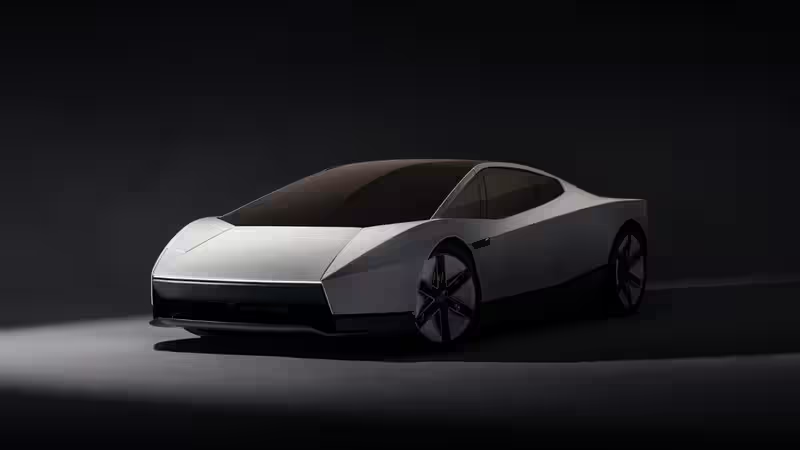
Tesla identifies the SR-71 and F-35 aircraft as design influences for the new Roadster. The vehicle features angular bodywork, concealed headlights, a full-width rear light, and flush-mounted surfaces. An Ano White finish draws on aerospace coatings, while gold-tinted glass and titanium accents continue the aircraft-inspired theme .
Inside, Tesla describes an Ultrawhite cabin with grey microsuede detailing. Manual controls and a fixed seat position are intended to reduce weight. Magnesium, titanium, and carbon fiber are used throughout the construction. The interior includes a steer-by-wire yoke, a central touchscreen, and two smaller forward displays .
A Track Mode changes the aerodynamic configuration, including deployment of the rear wing. Tesla claims aerodynamic downforce approaching Formula 1 levels, though comparable measurements and test conditions have not been provided .
Industry Context and Reception
The original Tesla Roadster, sold between 2008 and 2012, was the company’s first vehicle. It used a Lotus Elise chassis and helped change perceptions about electric cars by demonstrating that they could compete with combustion-engine sports cars .
The second-generation Roadster was first shown as a prototype in November 2017, with Musk promising deliveries would begin in 2020. The project has faced repeated delays since then .
Tim Levin, a senior editor at InsideEVs, said the Roadster could help revive Tesla’s image as an innovator, but cautioned that the market has changed. ‘Maybe back then the world needed convincing that EVs could be these superfast accelerating vehicles,’ Levin said. ‘But maybe now it won’t have the same impact as it would have had in 2020’ .
Gene Munster of Deepwater Asset Management described the demonstration as an engineering stunt without commercial value, except for embarrassing traditional automakers . Mikkel Thomsager, editor-in-chief of Denmark’s Bil Magasinet, said the presentation was typical Musk but viewed it as a stunt rather than a commercial product. ‘I see it rather as a stunt than a commercial product,’ Thomsager said. ‘Neither you nor I will probably ever fly in one of those. I don’t think it’s a car that will be mass-produced’ .
Tesla has been reducing its number of offered models as it refits production lines in California and Texas to build robots and autonomous taxis. Musk has played down the Roadster’s financial significance, saying sales would probably be modest and not ‘move the needle in a major way financially’ .
Analysts at Morningstar estimate sales of about 2,000 Roadsters per year, a small figure compared with the approximately 1.6 million vehicles Tesla sold last year .
Tesla reports third-quarter earnings on October 21, six days after the livestream event .