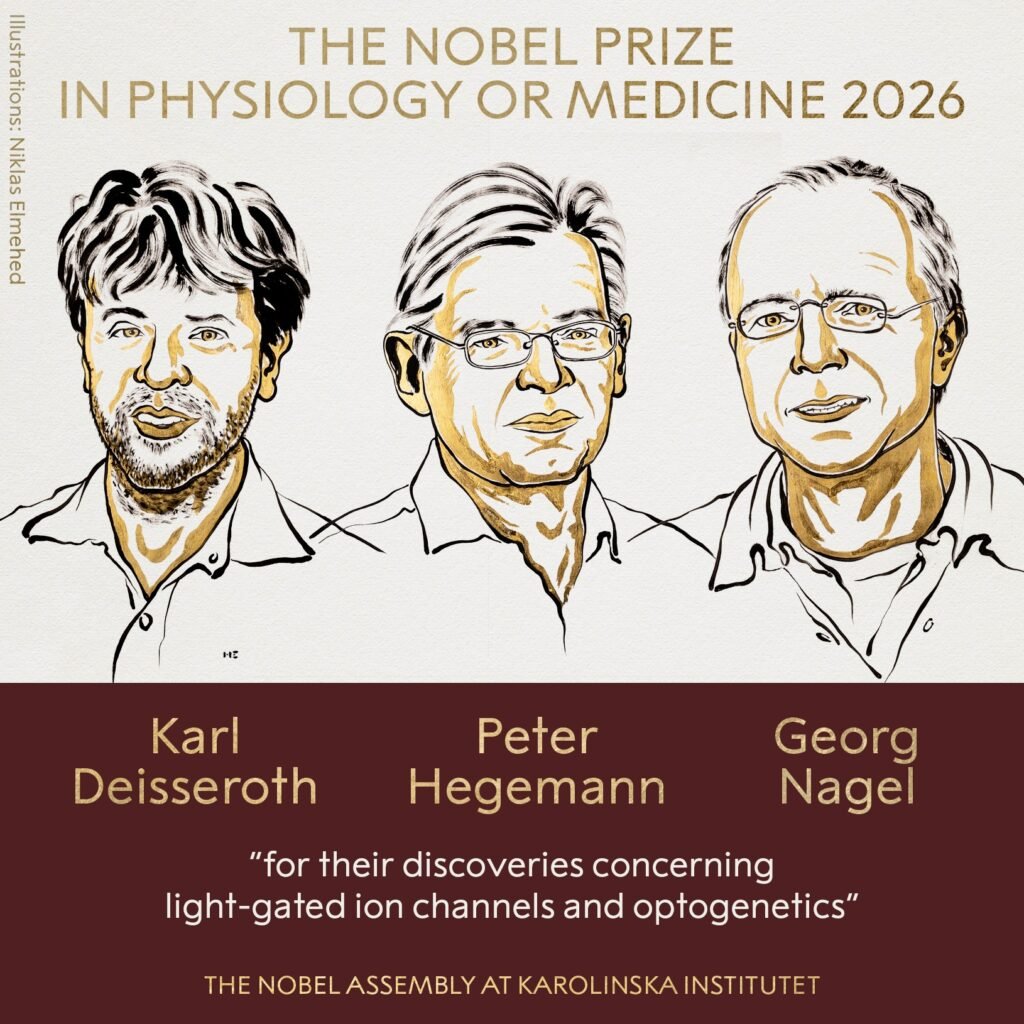
STOCKHOLM — The Nobel Prize in physiology or medicine has been awarded to three scientists for their discoveries concerning light-gated ion channels and optogenetics. Karl Deisseroth, Peter Hegemann and Georg Nagel received the honor on Monday for research that the Nobel Assembly said opened a new era in neuroscience.
The assembly said the method allows scientists to precisely turn on or off individual nerve cells using light, revealing how brain circuits shape behavior and disease. Deisseroth is based at Stanford University in California. Hegemann is at Humboldt University in Berlin. Nagel is at the University of Würzburg in Germany.
The three scientists will share prize money of 12 million Swedish kronor, approximately 1.2 million dollars.
The Scientific Discovery
The work began in the early 2000s when Hegemann and Nagel studied a single-celled green algae that can swim toward light. They discovered a protein called channelrhodopsin-2 that opens a channel when illuminated by blue light, creating an electrical impulse.
Deisseroth then inserted the gene for this protein into mammalian neurons. He demonstrated that light could control the firing of nerve cells with millisecond precision. In 2005, he published the breakthrough of using light to trigger neural signals in rat neurons. Two years later, he applied the technique to the brains of living mice.
The Nobel Assembly said optogenetics allows researchers to map brain circuits in ways previously only imagined. The method has become a standard tool in neuroscience laboratories worldwide.
Read More: Meta’s Muse Agent Wins Early Users, Raises Privacy Questions
Applications and Impact
Researchers now use the technique to activate specific neural circuits and study how memories, emotions and behaviors are formed. The assembly noted that the method has revealed neurons involved in neurological and psychiatric disorders. Studies have also explored optogenetics as a potential treatment for vision loss. Ongoing clinical trials are testing the approach in people blinded by retinitis pigmentosa, a disease that destroys the eye’s light-sensing cells.
The prize was announced at the Karolinska Institute in Stockholm, kicking off Nobels week. Thomas Perlmann, secretary of the medicine committee, said he was able to reach all three winners.
Deisseroth said he was working on papers and emailing students late at night when he received the call. He had just gone to lie down. He said no real sleep was achieved. The next task on his to-do list was to pack school lunches for his children, who were still asleep. Deisseroth said making their sandwiches was his one obligation in the next few hours.
Last year, the medicine prize went to three scientists researching the immune system. The award ceremony for this year’s laureates is scheduled for Dec. 10 at the Stockholm City Hall, the anniversary of Alfred Nobel’s death.