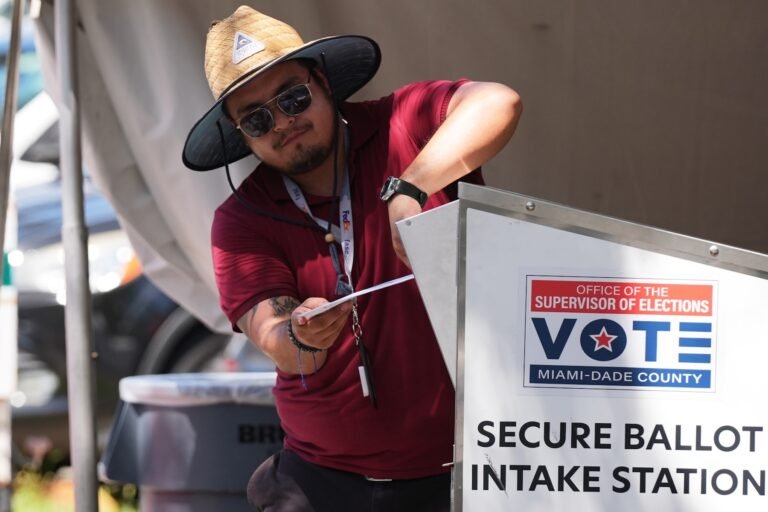
In the lead-up to the midterm elections on November 3, national-level activist groups and civil rights organizations have deployed millions of dollars and thousands of volunteers for an extensive campaign to encourage voter participation. The campaign focuses primarily on early voting and providing training to ensure the security of the electoral process. Groups associated with the ‘No Kings’ movement are organizing over 3,000 events across all 50 states and Washington, D.C., this Saturday. The initiative aims to set a record for the highest number of early votes cast in a single day in U.S. history.
According to the organizers, the campaign is intended to alleviate pressure on election staff and provide voters with sufficient time to resolve any registration-related issues before Election Day. Furthermore, these efforts seek to establish a network of volunteers to monitor polling stations and safeguard the integrity of the vote-counting process.
Table of Contents
ToggleThe journey from the ‘No Kings’ movement to the election
The No Kings coalition, which previously organized three nationwide protest days during Donald Trump’s second term, is applying its organizing infrastructure to voter turnout for the first time. The network includes hundreds of partner organizations such as Indivisible, the American Civil Liberties Union, and Black Voters Matter.
Ezra Levin, co-founder of Indivisible, stated that the coalition’s previous demonstrations were aimed at conveying a political message. “We have moved beyond just sending a message,” Levin said. He described the efforts planned for Saturday as a countermeasure against election interference, noting that the most effective response to such potential meddling is to significantly increase the number of early voters.
Hunter Dunn, an organizer with the 50501 network, explained that the coalition’s goal is to channel the energy of the movement into concrete action. “The objective is to transform people power into something tangible and useful,” Dunn said.
Events scheduled for Saturday range from block parties and cookouts to displaying signs along highways and organizing “dog-parade” marches. In Frisco, Texas, organizer Cami Dunford has planned a superhero-themed gathering, where participants will receive capes and masks, along with QR codes that link to voting information. “It doesn’t matter if you’re an independent, a first-time voter, a Democrat, or a Republican,” Dunford said. “If you are eligible to vote, you should get out there and cast your ballot.”
In states that do not offer in-person early voting—Alabama, Mississippi, and New Hampshire—organizers will focus on helping voters make a plan for Election Day.
Poll Watcher Training and Election Protection
A central component of the weekend’s activities is recruiting and training volunteers as poll monitors. Organizers say the training is a direct response to actions by the Trump administration and Republican-led state legislatures that they view as threats to election integrity .
Levin cited the failed SAVE America Act, which would have required documentary proof of citizenship for voter registration, as well as concerns about federal immigration officers being sent to polling sites and attempted restrictions on mail voting .
Poll monitors are being trained by Common Cause, a government watchdog group. Volunteers wear identifying T-shirts at polling places so voters can approach them with questions . In Sarasota, Florida, organizer Sarah Parker said small gatherings matter even in conservative areas, pairing rallies with virtual events and education sessions on becoming a poll monitor .
Leah Greenberg, co-founder of Indivisible, said voting early interrupts what she described as an authoritarian playbook that relies on creating confusion around the voting process. ‘It ensures that voting is a season rather than a single day,’ Greenberg said .
Record early voter turnout in Georgia and Minnesota
Data from the early voting process indicates a higher level of active participation. According to the Secretary of State’s office, Georgia saw a record-breaking turnout on the first day of in-person early voting, with a total of 188,667 votes cast. This figure represents a 40% increase over the 134,962 votes cast on the first day of the 2022 midterm elections, and is more than double the 70,849 votes recorded on the first day in 2018.
Data from ‘VoteHub’ shows that more than 36% of the votes cast in Georgia on the first day came from Black voters—an increase of six percentage points compared to previous figures. Additionally, 10,267 absentee ballots had been received as of Tuesday.
In Minnesota, more than 200,000 voters have exercised their right to vote since the early voting period began four weeks ago. Election officials had distributed 519,813 absentee ballots; of these, 80,000 have been cast in person, while 121,000 have been returned by mail. During the same period in the previous midterm election, a total of 172,520 votes were recorded.
The state’s new voting rules have come into effect
In many Republican-controlled states, efforts are underway to mobilize voters amidst a shifting legal landscape. More than three dozen voting laws—passed by Republican-led legislatures—are taking effect for the first time this year. Many of these laws incorporate elements of proposals that Donald Trump had unsuccessfully pursued at the federal level.
New Hampshire has removed student identification cards from the list of acceptable forms of ID for voting. In Utah, voters are now required to provide additional information on the envelopes used for mail-in ballots. In Mississippi, voters may, in certain instances, be required to present a birth certificate or passport to verify their identity.
Ohio has mandated that proof of citizenship be provided when registering to vote at the Bureau of Motor Vehicles. The state has also eliminated a four-day grace period for mail-in ballots, which must now arrive by Election Day. Furthermore, the state is conducting an effort to remove names from voter rolls—a move that voting rights groups have challenged in court.
Freda Levenson, legal director for the ACLU of Ohio, warned that the use of outdated databases could result in eligible voters being disenfranchised. “There is a risk that countless eligible voters could be denied the right to vote,” Levenson stated.
In Texas, officials in Tarrant County have reduced the number of early voting locations from 50 to 47, and Election Day polling sites from 316 to 224. According to a lawsuit, there is not a single polling station located within the 76103 zip code—an area where 76 percent of the residents are Black or Hispanic.
The Texas Department of Public Safety has also revealed that it failed to process at least 500,000 voter registration applications submitted through its online driver’s license portal—with some facing delays of up to a year. County election officials are now working extra hours to clear the backlog.
The NAACP has launched its largest-ever midterm election campaign
The NAACP has launched what it describes as its largest get-out-the-vote campaign for a midterm election in its 117-year history, a $20 million effort targeting 6.5 million Black voters across 33 congressional districts . The campaign includes 20,000 volunteers and focuses on registration, door-to-door canvassing, and voter education through Election Day.
Tyler Sterling, National Campaign Director for the NAACP, stated that his organization is focusing specifically on certain constituencies in states like Michigan and New York, as well as on local elections—such as those for sheriffs and county commissioners—in Southern states. “We are continuing on the same path,” Sterling said, “to ensure that the democracy—for the preservation of which Black voters fought so hard—continues to work effectively for us today.”
According to Cornell William Brooks, who served as president of the NAACP from 2014 to 2017, local branches are best positioned to lead these efforts. “In most communities, the NAACP acts as a ‘911’ (emergency service) for democracy,” Brooks remarked. “People actually call the organization—not just metaphorically, but for real, tangible assistance.”
This civic engagement campaign comes in the wake of a Supreme Court ruling in April that further weakened the Voting Rights Act. Following this decision, several Republican-led states began redrawing congressional district maps. The NAACP has filed lawsuits in Missouri, Tennessee, and Texas challenging these new maps.
Democratic and labor union campaigns to increase voter turnout
Earlier this month, the Democratic National Committee (DNC) organized a national mobilization call to encourage voter turnout, featuring Vice President Kamala Harris, DNC Chair Ken Martin, and AFL-CIO President Liz Shuler. Harris urged participants to focus on engaging with voters, stating, “There is so much good work to be done in our beautiful country, and we are all focused on the same goal: empowering people by making them realize that their vote matters.”
Shuler noted that, through its “labor-to-labor” program, the labor movement has already knocked on 700,000 doors and made 2.2 million phone calls. “Together, we will get this job done with full force,” she said.
Martin highlighted that Democrats across the country are investing in door-to-door canvassing and phone-banking efforts. “By taking an aggressive approach and putting in this work, Democrats have a real chance to win seats—even in places where Trump previously won by double-digit margins,” Martin said.
Also Read: Five-Day Press Secretary Stint Sparks Wave of Shortest Job Tenure Stories.
Availability of early voting expanded in most states
According to the Brennan Center for Justice, 97 percent of eligible American voters will be able to cast their ballots before Election Day this year. In the 2022 midterm elections, nearly half of the electorate—47 percent—voted either early or by mail.
New Jersey and Virginia have extended their early voting periods this year, while Nebraska has simplified the process for requesting mail-in ballots and correcting errors on them. Only Alabama, Mississippi, and New Hampshire do not permit in-person early voting; however, all three states offer some form of absentee voting for eligible voters.
By mid-October, more than 200,000 people in Minnesota had already cast their votes, and a record-breaking turnout on the first day of early voting in Georgia signaled a sustained enthusiasm for the process. Organizers anticipate a steady increase in early voting throughout the final weeks leading up to November 3, and the group ‘No Kings’ plans to conduct follow-up outreach and deploy observers to polling stations right up until Election Day.