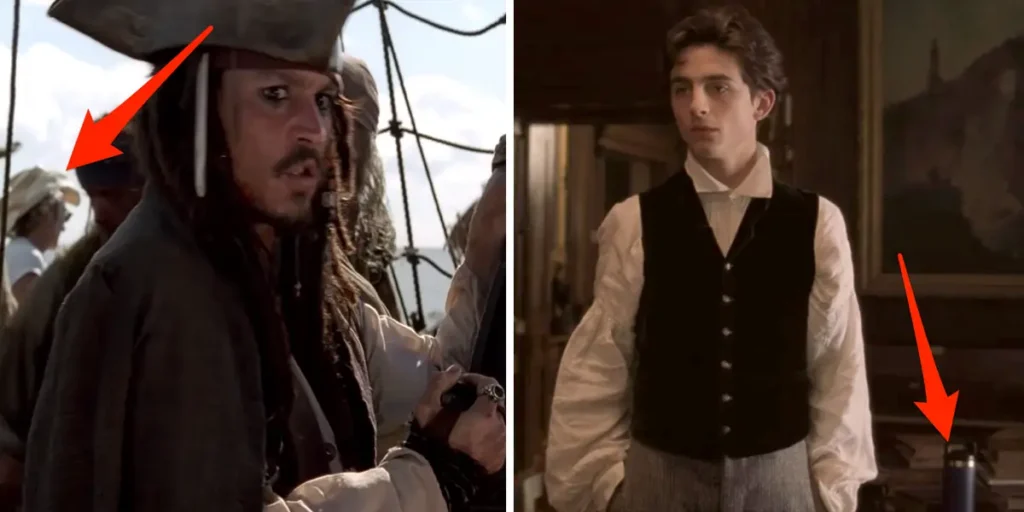
Audiences are identifying small historical errors in period films, television shows and video games, from modern medical products visible on screen to toys and technologies released years after the events depicted.
The scrutiny has intensified as high-definition streaming and social media platforms allow viewers to pause, zoom and share frames instantly. These findings often spread quickly, prompting public discussion about the line between artistic license and historical accuracy.
Modern Items in Period Settings
Netflix’s Bridgerton, set in Regency-era England, has faced repeated criticism for modern objects appearing on screen. In the fourth season, viewers spotted a small, flesh-colored Band-Aid on the ear of actress Katie Leung, who plays Lady Araminta, during a masquerade ball scene.
Adhesive bandages were not invented until 1920, more than a century after the show’s early 19th-century setting. Fans on TikTok suggested the patch was likely covering a cartilage piercing and criticized the editing team for failing to conceal it with a period-appropriate accessory such as an ear cuff.
This is not the first such error in the series. In the first season, yellow parking lines were visible on a cobblestone street. Parking lines were not introduced in the United Kingdom until the 1950s.
Other productions have faced similar findings. In Greta Gerwig’s 2019 adaptation of Little Women, a TikTok user identified a modern Hydro Flask water bottle and a Poland Spring plastic bottle in a scene. The user noted she had watched the film seven times in theaters before noticing the objects during a home viewing.
Real People and Impossible Details
James Cameron’s Titanic has been studied for historical accuracy since its 1997 release. While historians have praised the production’s recreation of the ship, specific errors have been documented.
In the film, Jack, played by Leonardo DiCaprio, mentions ice fishing on Lake Wissota in Chippewa Falls, Wisconsin. The man-made lake was not completed until 1917, five years after the Titanic sank.
Other anachronisms include characters using phrases and referencing artwork that did not exist in 1912. Rose, played by Kate Winslet, uses the phrase ‘masters of the universe,’ a term popularized by Tom Wolfe in the 1980s. Jack quotes a lyric from Bob Dylan’s 1964 song ‘Like a Rolling Stone.’ Additionally, Pablo Picasso’s painting Les Demoiselles d’Avignon, created in 1907, is shown in Rose’s cabin, though there is no record of it being aboard the ship.
In the 1996 Titanic miniseries, a steerage bathroom is depicted with shower stalls, though the real Titanic’s third class had only two bathtubs for all passengers and no showers.
Digital Games and Historical Claims
Video games with historical settings also draw scrutiny. Call of Duty: Vanguard, set during World War II, faced criticism from players who argued its diverse representations and certain gameplay elements conflicted with the period’s typical military composition.
The debate around historical accuracy in games often involves competing claims about what ‘accuracy’ means. Kingdom Come: Deliverance, set in 15th-century Bohemia, was criticized for its lack of non-white characters, with its director stating he was making a game about the history of his country ‘as it really was’.
Conversely, Assassin’s Creed Unity, set during the French Revolution, drew criticism from French politicians and historians who argued its portrayal of revolutionary figures was politically skewed. Jean-Luc Mélenchon, a French politician, said the game was ‘smearing the great revolution’.
The ‘iPhone Face’ Phenomenon
A related discussion has emerged around actors’ appearances in period productions. Social media users have coined the term ‘iPhone face’ to describe actors whose features appear too modern for historical roles, often due to cosmetic procedures such as lip fillers, Botox, veneers and eyebrow lifts.
Actors including Timothée Chalamet, Dakota Johnson and Lily-Rose Depp have been cited in online discussions about this phenomenon. An ethnologist at Cornell University stated that human facial features have not changed significantly over recent centuries, suggesting the perceived mismatch stems from evolving beauty standards rather than biological differences.
A TikTok video on the topic, posted in January 2025, received over five million views and nearly one million likes. The creator said actors ‘cannot star in a period piece’ if they look like they have had cosmetic procedures.
Also Read: Art of Play Says Kelly Clarkson’s Singing Bird Molly Is Not for Sale Amid Online Dispute.
The findings continue to accumulate as viewers document and share details from new releases and older productions alike.