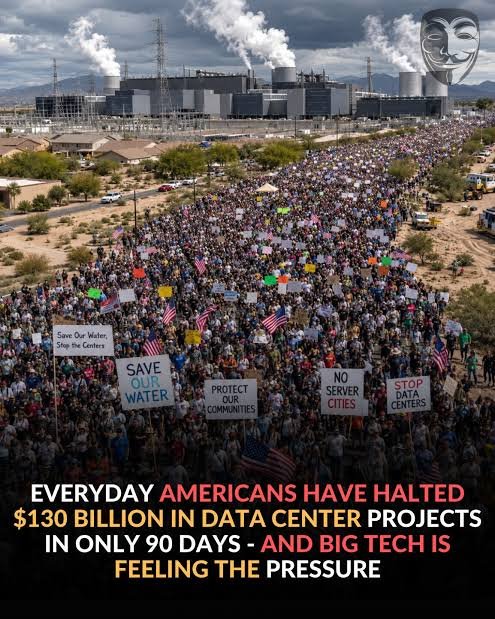
Communities across the United States, India, and Europe are mounting organized opposition to the rapid expansion of hyperscale data centers, citing concerns over noise pollution, water consumption, rising electricity costs, and billions in tax incentives granted to the world’s wealthiest technology companies.
The backlash represents one of the most significant challenges to the artificial intelligence infrastructure boom, with tens of billions of dollars in projects delayed or blocked by local resistance.
A Global Pattern of Local Revolt
From the suburbs of Virginia to the outskirts of Mumbai, residents have increasingly rebelled against the spread of AI data centers, complaining of noise, surging electricity consumption, water stress, and the industrialization of residential neighborhoods.
The resistance is particularly acute in India, where Amazon, Google, and Microsoft are pouring billions into facilities that advance Prime Minister Narendra Modi’s ambition to host the world’s data. In Thane, near Mumbai, more than 1,000 residents living near a planned 54-acre Amazon facility say the project was pushed through without meaningful consultation.
Tushar Shetty, a 46-year-old engineer whose apartment overlooks the construction site, described the transformation of what was once lush greenery into a scar of red earth where trees were felled. ‘I would not have bought the house if I had known,’ said Shetty, who purchased the property just five months before construction began.
On September 8, hundreds of residents gathered beside the site holding placards reading ‘Data centres are energy vampires.’ Vasudha Shetty, 62, who bought a flat near the facility, stated: ‘If the data centre stops, we will stay. If it goes ahead, we will move.’
Amazon Defends Thane Project
Amazon has published detailed responses to resident concerns. The company said the Thane facility would not use water for cooling. ‘Amazon’s data centre development in Thane will not use any water for cooling.
In fact, we do not currently use water for cooling in any of our data centres in India, and do not draw from the community’s drinking or potable water for cooling purposes,’ the company said.
The approved water supply permit for the facility is 0.01 million litres per day, intended only for basic human needs such as drinking water and restrooms for employees. Amazon added that the facility would use air-cooled chillers and closed-loop cooling technology.
Residents, however, remain concerned about heat generation. Gurasis Singh, a local resident, said the facility would use approximately 80,000 air conditioners. ‘It is going to create a heat island in Balkum, Dhokali and Majiwada areas,’ Singh said. ‘Every year in summers, temperatures are already hitting new highs.’
Amazon rejected the claim that heat from the facility would raise temperatures in surrounding communities, saying heat management had been incorporated into the facility’s design.
On electricity, residents fear that a hyperscale data center requiring 420 megawatts of uninterrupted power could strain local infrastructure. Jatin Kothare, a resident, said: ‘This plant is coming up next to an electricity grid. A hyperscale data centre requires a heavy, uninterrupted supply of 420 MW. We have already witnessed a power cut in the last few months.’
Amazon said local electricity consumers would not be affected, stating the facility would receive power through a dedicated extra-high-voltage substation and would not draw power from the local distribution network serving homes and businesses.
Water Stress and Scarcity
India holds 4% of the world’s freshwater for 18% of its people, and data centers are clustering in cities already short of it. S&P Global estimates 60% to 80% of Indian data centers could face high water stress this decade.
In 2025, data centers in India used about 150 billion litres of water, a figure projected to more than double by 2030, according to research firm Mordor Intelligence.
In the United States, more than a billion liters of water are consumed daily by data centers, both directly for cooling and indirectly for other functions. Large data centers can consume up to 5 million gallons per day, equivalent to the water use of a town of 10,000 to 50,000 people, according to U.S. Senator Ron Wyden of Oregon.
Wyden pressed the heads of Google, Apple, Meta, and Amazon in April to answer questions about their companies’ use of technologies that minimize groundwater withdrawals. ‘Many communities in my state are concerned about how these centers could contribute to water scarcity in the coming years, especially as our state grapples with persistent drought,’ Wyden wrote.
Tax Breaks Under Scrutiny
Congressman Don Davis and Congresswoman Kristen McDonald Rivet led 25 members of Congress in introducing H.R. 10448, the Reverse Big Ugly Tax Breaks for Data Centers Act, which would rein in tax giveaways for data center development.
The bill would exclude data centers from the 100% bonus depreciation tax deduction and from eligibility for Opportunity Zone tax benefits, which were expanded under the One Big Beautiful Bill Act.
‘When families are struggling at the pump, in the grocery store, and with rising utility bills, we cannot give data centers a blank check,’ said Congressman Don Davis. ‘We need time to fully understand the costs and consequences of these projects, including their impact on power grids, water systems, and utility costs for rural communities across eastern North Carolina and our nation.’
Congresswoman McDonald Rivet stated: ‘Washington is giving handouts to Big Tech companies while American families are drowning. Tax cuts need to go to families, not data centers.’
A report from Senate Democrats found that generous state and local tax breaks for data center construction are causing the loss of billions in tax revenue. ‘Even though data center development is dominated by some of the wealthiest companies in the world, these same companies are not doing enough to pay their fair share,’ the report said. ‘This leaves ratepayers, taxpayers, and local communities shouldering many of the costs while Big Tech reaps the benefits.’
Rising Power Bills
Electricity demand associated with artificial intelligence is growing rapidly as hyperscale data centers expand to multi-gigawatt scale. Recent estimates suggest that electricity use for AI training alone could reach approximately 1000 TWh by 2030, corresponding to several percent of current global electricity demand.
Data centers already consume around 5% of total electricity demand in the United States, up from 2% a decade ago, with projections approaching 10%. Gartner projects that electricity consumption by data centers grew by 16% in 2025 and is expected to double by 2030.
In the U.S., electricity prices are projected to rise by more than 5% in 2026. This creates increased public friction when electricity gets more expensive for everyone, as large power users attract more public scrutiny.
Regulatory Responses
In Ireland, the Commission for Regulation of Utilities has published a Large Energy User Connection Policy requiring new data centers seeking grid connections to match their demand with equivalent onsite or local generation or storage capacity and meet an 80% renewable energy target.
In Texas, Senate Bill 6 mandates a kill switch function, giving grid operators the authority to disconnect data centers during emergencies to protect overall grid integrity.
Italy’s Lombardy region has enforced environmental laws to regulate data center siting. Structures with 5 MW or less capacity are deemed edge data centers permissible within urban areas, whereas a 10 MW center would require a territorial agreement including compensatory measures.
Industry Responses
Major technology companies have signed a White House pledge to bear the costs of new or additional power supply and transmission infrastructure for data centers without passing those costs to households or small business consumers.
OpenAI announced a new data center in Effingham County, Georgia, with a commitment to invest $80 million in the local community and provide up to $71 million in coding tool credits to local students.
Amazon is drawing up community outreach plans to address concerns over noise, water, and power in India. ‘Building data centres comes at a cost. Amazon at a global level is prepared to work with community and limit any inconvenience,’ a person familiar with its planning said. ‘For now there is no other option but to live with protests.’
The NAACP released a playbook in January outlining recommendations for responsible data center development, calling for meaningful community engagement and consent before siting or expanding data centers, transparency and accountability measures, and community investment commitments.
‘Data centers are not abstract, and the patterns are that they are physical facilities that consume massive resources and too often pollute the same neighborhoods already burdened by industry,’ said Abre’ Conner, Director of the NAACP Center for Environmental and Climate Justice.
As of October 2026, the Thane project remains under construction despite ongoing protests. Amazon continues to operate under its stated commitments of water-free cooling and dedicated power supply. The Walla Walla County public comment period on Amazon’s permit application runs through October 12.