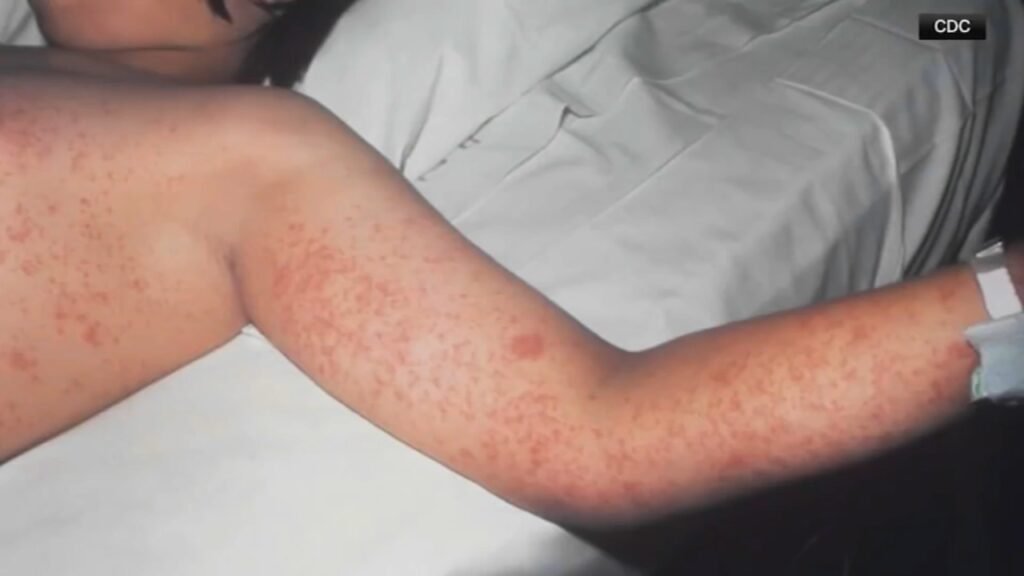
Pennsylvania’s measles outbreak has surpassed 1,000 confirmed cases, marking the largest state outbreak in the United States in more than three decades. New York Governor Kathy Hochul declared a statewide disaster emergency on Monday in response to the growing spread of the disease across rural areas.
The Pennsylvania Department of Health reported 1,004 confirmed measles cases across 39 counties as of Monday. The outbreak has resulted in 198 hospitalizations and five measles-associated deaths.
Only four of Pennsylvania’s 1,004 cases have occurred among fully vaccinated individuals, according to state health officials. The current outbreak began in April in an area west of Philadelphia.
Lancaster County remains the epicenter of the Pennsylvania outbreak with 391 confirmed cases. The county has significant Amish and Mennonite populations, and health officials have attributed the spread to low vaccination rates in affected communities.
Two of the deaths were unvaccinated adults, including an 18-year-old and a 40-year-old. Two other deaths were among infants too young to receive the measles, mumps, and rubella vaccine. The fifth death occurred in an unvaccinated Lancaster County resident.
More than 53,000 MMR vaccine doses were administered statewide in September, according to the Pennsylvania Department of Health. This represents more than twice the number typically given in a month.
New York Declares Emergency
New York Governor Kathy Hochul issued an executive order declaring a State Disaster Emergency in response to measles cases across rural areas of New York and neighboring states. The emergency took effect on Monday and runs through November 4.
New York has reported 108 measles cases this year through October 3. Seven cases are in New York City and 101 are elsewhere in the state. Since July 15, 92 cases have been reported among under-immunized rural communities in 18 counties.
The executive order expands the pool of healthcare professionals authorized to administer measles vaccines. Paramedics, advanced EMS providers, pharmacists, and midwives can now give the vaccine. Nurses are also permitted to order testing for suspected measles cases.
The order allows pharmacists to vaccinate children as young as two years old. It requires all MMR vaccinations to be reported to state or New York City immunization registries within 72 hours. Vaccination itself still requires consent from the patient or a legal guardian.
Local health departments have administered more than 1,000 MMR vaccine doses in rural areas of New York since July 15. The state has also launched a Measles Dashboard to help the public and healthcare officials track local health risks.
Governor Hochul said: ‘No one should get seriously ill or die from a vaccine-preventable disease. That is why I have taken steps to increase the number of health professionals who can vaccinate and test. These emergency measures will protect New Yorkers and support our community partners as they work tirelessly to address the spread of this disease.’
New York State Department of Health Commissioner Dr. James McDonald said: ‘I appreciate Governor Hochul’s swift action to help address ongoing measles cases. Department staff are working closely with local health departments and regional partners to track and contain the current measles outbreak. The measles, mumps, and rubella vaccine is the best protection — protecting nearly all people against disease who receive the recommended doses. I urge New Yorkers to check their vaccination status and make sure that they and their families are protected. I also ask health providers to be prepared to diagnose and treat any measles cases they encounter.’
Read More: Siberian Lab Worker Dies After Suspected Plague Infection as Nearly 200 Placed Under Observation.
National Toll Reaches 35-Year High
The United States is experiencing its worst measles year since 1991, with nearly 3,900 cases reported nationwide, according to the Centers for Disease Control and Prevention. The 2025 total of 2,289 cases had already marked the highest annual count in more than three decades before being surpassed this year.
Measles was declared eliminated in the United States in 2000. For the quarter century that followed, there were an average of approximately 180 measles cases per year nationwide, according to federal data.
National MMR vaccination coverage among kindergarteners has declined from 95.2 percent during the 2019-2020 school year to 92.5 percent in the 2024-2025 school year. This falls below the 95 percent coverage target needed to prevent community outbreaks.
The CDC has reported that 93 percent of measles cases this year are outbreak-associated. The vaccination status of 93 percent of cases is unvaccinated or unknown.
International health officials are scheduled to meet in November to determine whether the United States and Mexico have lost their measles elimination status.
A dispute between Pennsylvania Governor Josh Shapiro and US Health Secretary Robert F. Kennedy Jr. has affected how measles deaths are classified at the federal level. Shapiro has publicly criticized Kennedy, while Kennedy has questioned whether Pennsylvania’s recorded fatalities were directly caused by measles. The CDC currently lists two measles deaths in the United States this year, while Pennsylvania has reported five.