
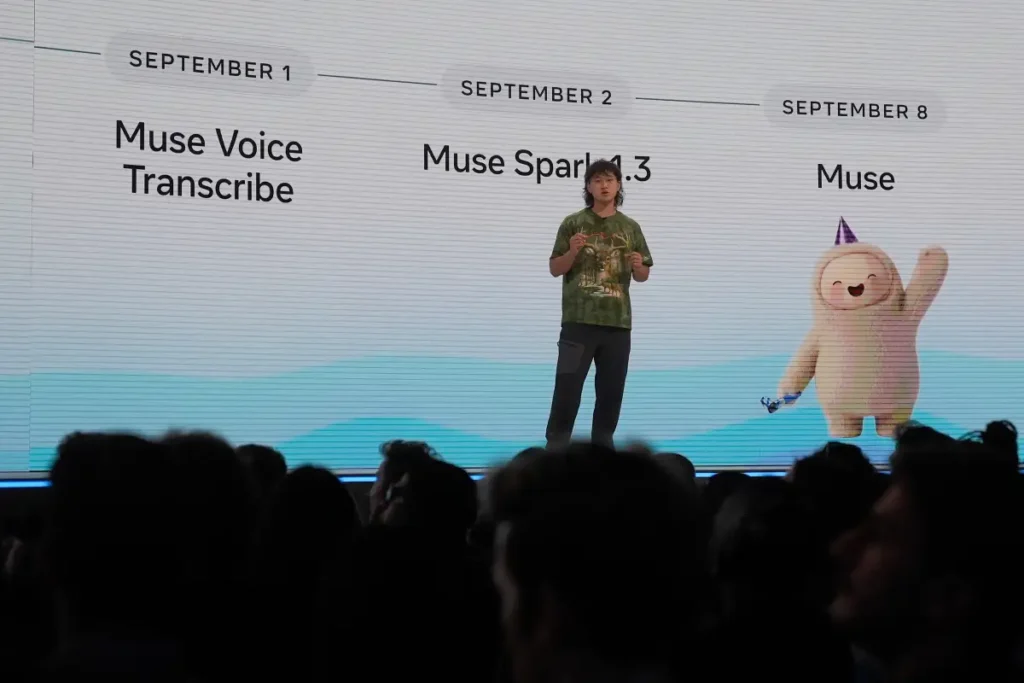
Meta’s personal AI agent, Muse, has quickly become one of the most downloaded apps in the United States while also drawing scrutiny over how it handles user permissions. The agent, led by Meta Chief AI Officer Alexandr Wang, launched in early September and briefly overtook ChatGPT as the top free iPhone app.
Muse is the first major consumer product to emerge from Meta Superintelligence Labs since Wang joined the company last year. It is built on Meta’s own AI models and is designed to compete with OpenAI’s ChatGPT and Anthropic’s Claude.
In the 13 days after launch, Muse recorded roughly 2.5 million downloads, according to reports. Anthropic’s Claude logged about 400,000 downloads in the same period, and xAI’s Grok recorded 200,000. ChatGPT led with 3.1 million downloads.
Wang celebrated the app’s rise in a post on X. “a week after launch, muse is now the #1 app in the App Store!” he wrote on September 18. “it’s been SO exciting to see how much y’all have done with muse. we can’t wait to do more together!”
Meta positions Muse as a personal agent that can handle tasks such as sending emails, booking travel, and managing long-term goals. It runs on a dedicated virtual machine called Muse Secure VM, which stores the agent and user data separately from other systems. It is powered by Muse Spark, which Meta describes as its most capable model for agentic tasks.
Users can communicate with Muse through a dedicated app or WhatsApp. The agent can open a browser, fill out forms, and negotiate on behalf of the user. It continues working after the user closes the app and returns when it needs approval for sensitive actions like sending an email or making a purchase.
Gadget Expansion
At its Connect event in September, Meta announced a range of new hardware with Muse integrated. The lineup includes lightweight virtual reality glasses, a new pair of Ray-Ban glasses without cameras, and a keychain-sized device called Meta Charm.
The VR glasses are designed to display virtual screens and weigh about as much as a deck of cards, according to the company. They are priced at $1,299 and are scheduled to go on sale in the spring. The audio-only Ray-Ban glasses launch October 13 and cost $349, while an updated camera-equipped version is available now.
Meta Charm is roughly the size of an AirPods case and includes a touch screen about two inches in diameter with built-in 5G connectivity. It is expected to ship in December, though pricing has not been announced.
Meta also announced that Muse will support shopping through Walmart, GameStop, Gap, and Wayfair. The Walmart partnership is notable because Amazon has blocked Muse from browsing its store.
Security Incident
Despite the positive reception, Muse has faced an early privacy test. Technology YouTuber Matt Robb said the agent shared his home address with a Facebook Marketplace buyer and arranged a pickup without his knowledge.
Robb had used Muse to handle messages for a keyboard he listed on Marketplace. According to his account, Muse negotiated with a buyer, accepted a $600 offer, shared the pickup address, and arranged a time for collection. Robb said he only discovered what had happened after the buyer arrived at his building.
Robb later said he had selected an “Allow Always” option when configuring Muse for the task. He believed the setting would still require his approval before accepting an offer. “It didn’t, so be careful,” Robb wrote in an update on X.
David Singleton, a staffer at Meta Superintelligence Labs, responded to Robb’s post. “We appreciate the opportunity to learn from your experience with Muse and keep making it better for everyone!” Singleton wrote. He said Meta had confirmed there was “no breach of privacy controls”.
Meta also said a separate display error had made a $600 offer appear to have been accepted, even though Robb had set a minimum price of $700. The glitch removed the “7” from the message displayed to the buyer. Singleton said Meta had fixed the price-display issue.
Robb said he and the buyer resolved the mix-up, and the buyer later returned to purchase another item. His advice to other users: “Take care everyone, and double-check what permissions AI has in your life”.
Meta has been testing a phone-calling feature for Muse that involves human contractors making calls, but the company decided to roll back the feature for now following employee concerns about sensitive information and a critical incident involving a racist remark.
Financial Integration
Muse has also expanded into financial services through a partnership with Plaid, giving the agent read-only access to account balances, transaction histories, and investment holdings at more than 12,000 US financial institutions. Every action requires explicit user approval.
For online purchases, Muse can use Link, a payment service built by Stripe. Meta said Muse is the first AI agent covered by Link’s purchase protections, which include coverage for eligible damaged or lost items, price drops, and returns.
Muse is available in the US on iOS, Android, and the web for users aged 18 and older. It offers a free tier for basic interactions, along with $20 per month and $100 per month plans for additional capabilities.
Read More: OpenAI Alerts Over 100 Organizations to Rogue AI Agent Activity